Of kings and coins, castles and cavalry – and a yoke around our necks?
8 Jun 2026
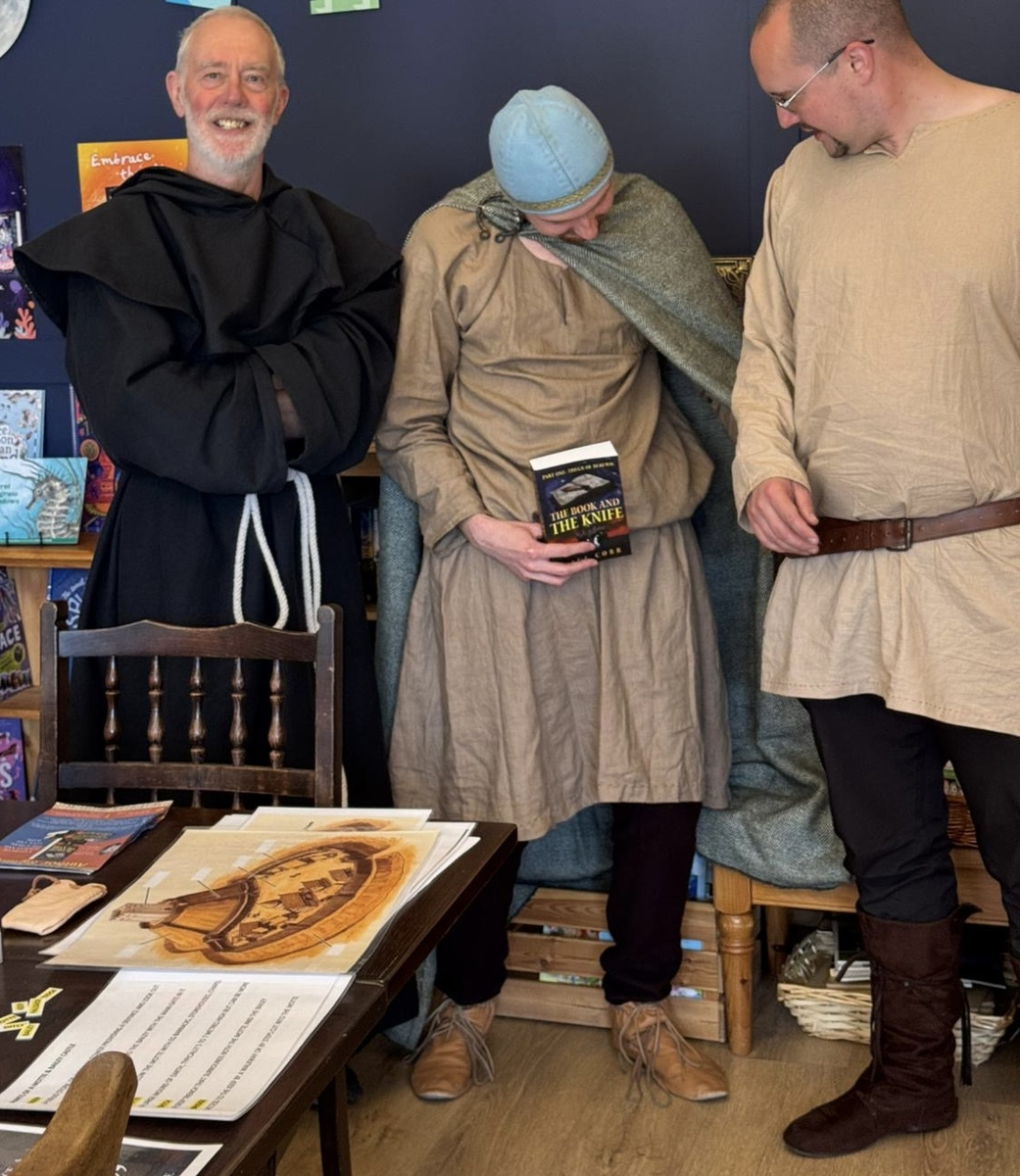
This spring I’ve been going to events in character as Felip, the monk from the Languedoc, in the company of Wynflæd from the manor of Berewic, and giving short talks. It’s huge fun and I feel like I’m giving something back when I tell people ‘Did you know…?’
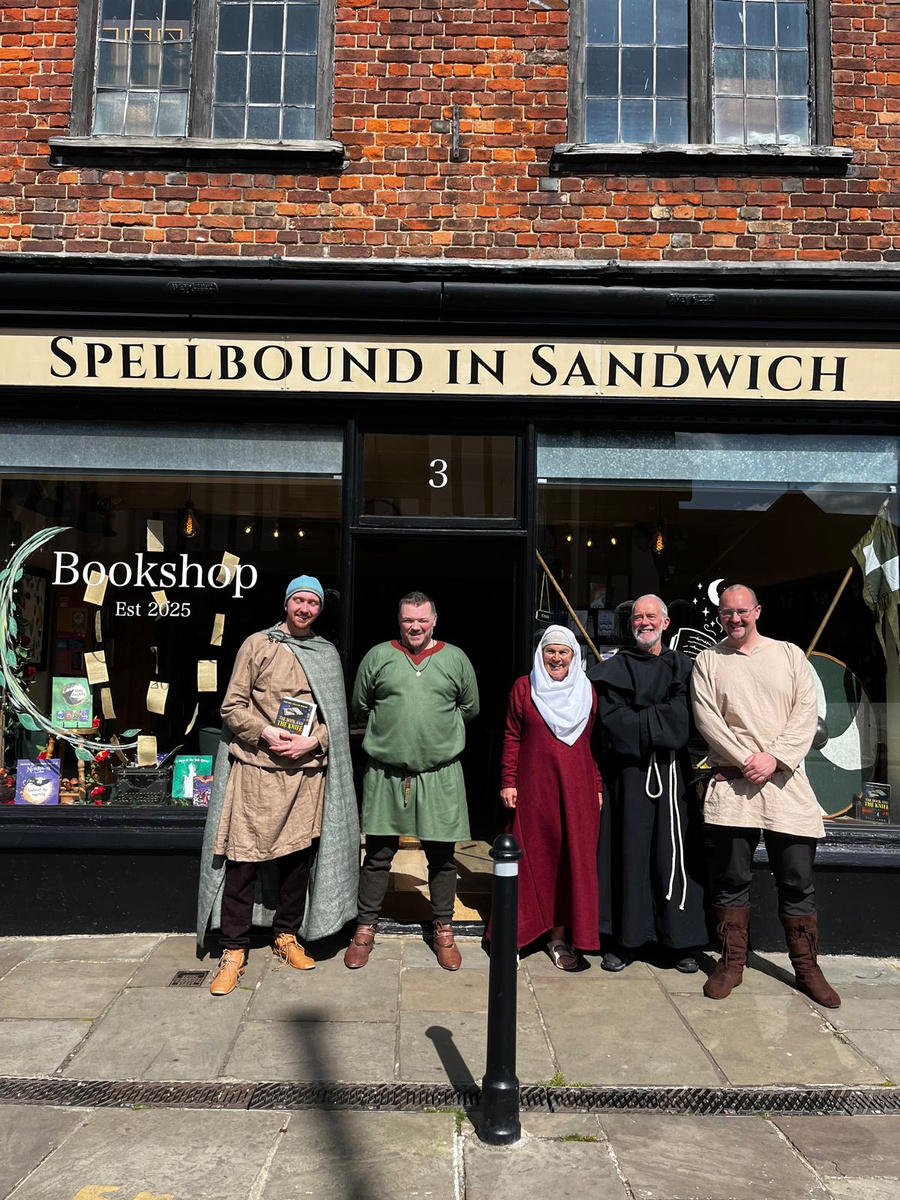
When Felip and Wynflæd took the Spellbound in Sandwich bookshop back to the 11th Century for a book signing, a steady stream of people came through the day. Phil AKA Frodi the Moneyer brought his superb Norman Knight kit along and made Anglo-Saxon coins during the day, and Jamie and Leo popped in from the Sandwich Mediaeval Centre in their gear. My thanks to owner Abigail Worthington for opening all day – it’s a lovely bookshop with a great range of books, vinyls, cards and other goodies to come and browse and puts on great events at 3 Cattle Market Sandwich CT13 9AE.
I did a talk on coinage, followed by an extract from Thegn of Berewic.
Anglo-Saxon Kings and Coins
It is the year 930. Athelstan, King of England by the grace of God, has written his Second Code of Laws for the good governance of his people. Clause 14 of the Code states:
‘Concerning moneyers; there is to be one coinage over all the king’s dominion, and no-one is to mint money except in a town.’
‘In Canterbury there are to be 7 moneyers; four of the king, two of the bishop, one of the abbot; in Rochester 3; two of the king, one of the bishop; in London 8…’ and so on.
By the year 930, Athelstan has completed the reconquest of the Danelaw, the process begun by his grandfather Alfred the Great. An ‘Engla-lond’ has taken shape; a land its inhabitants recognise as their country, whatever part of it they live in, ruled by one king, worshipping one God. And it has one coinage, money that can buy and sell goods anywhere from Wessex to Northumbria. Coinage is a significant mark of a nation state, but much more than legal tender. As royal propaganda, it advertises royal control and literally projects kingship, given that the image of the king on a coin would be the only one most people would ever see.
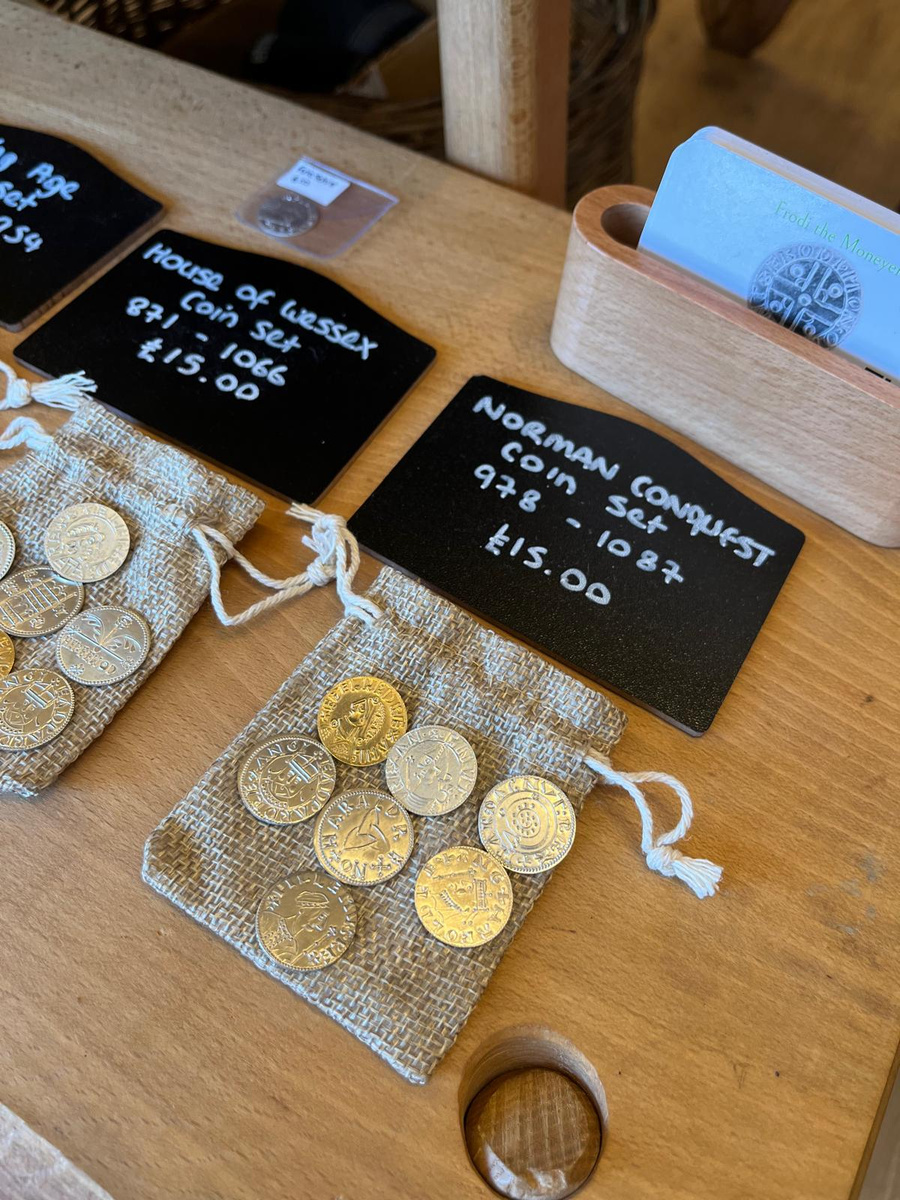
Sets of Frodi the Moneyer's coins
There were mints in market towns scattered across England, all within a dozen miles of each other so that coins can safely be carried to and from them in daylight. The moneyer who worked in these town mints had to be a trustworthy person. In major centres like London, Canterbury and Winchester, he would be a full time official appointee, or in smaller towns, a local jewellery maker or metalsmith.
Coin production makes the king – and England – wealthy. Coins are issued for limited periods – after two or three years, they are recalled and taken back to the mint. The staple coin is the penny; made of a soft silver alloy, it can be shaved or clipped, so periodic reissue makes counterfeiting coinage harder. Reissue has another purpose – when you take your bag of coins to the mint, for every 10 old pennies you return you get 8 or 9 new ones. The king hangs on to the rest as a tax revenue, and the moneyer is effectively the king’s tax collector!
By the year 1000, there are more than seventy mints across England, though Sandwich doesn’t get its mint until c. 1043, when it was set up under Edward the Confessor. Seventy mints equate to about 5-10 million coins being produced every two or three years, mainly from imported silver, especially from Germany. All this minting and tax revenue makes England wealthy. It pays the Danegeld, the tribute demanded by the invading Vikings, but it also makes England a rich prize – attracting the covetous gaze of other potential invaders like the Normans…
But there is another part of Clause 14 of Athelstan’s Second Code of Laws:
‘And if a moneyer is convicted of issuing base or light coins, the hand with which he committed the crime is to be struck off, and put up on the mint…’
Luckily, my audience in Sandwich didn’t think Frodi was guilty of such a crime, and he was let off…
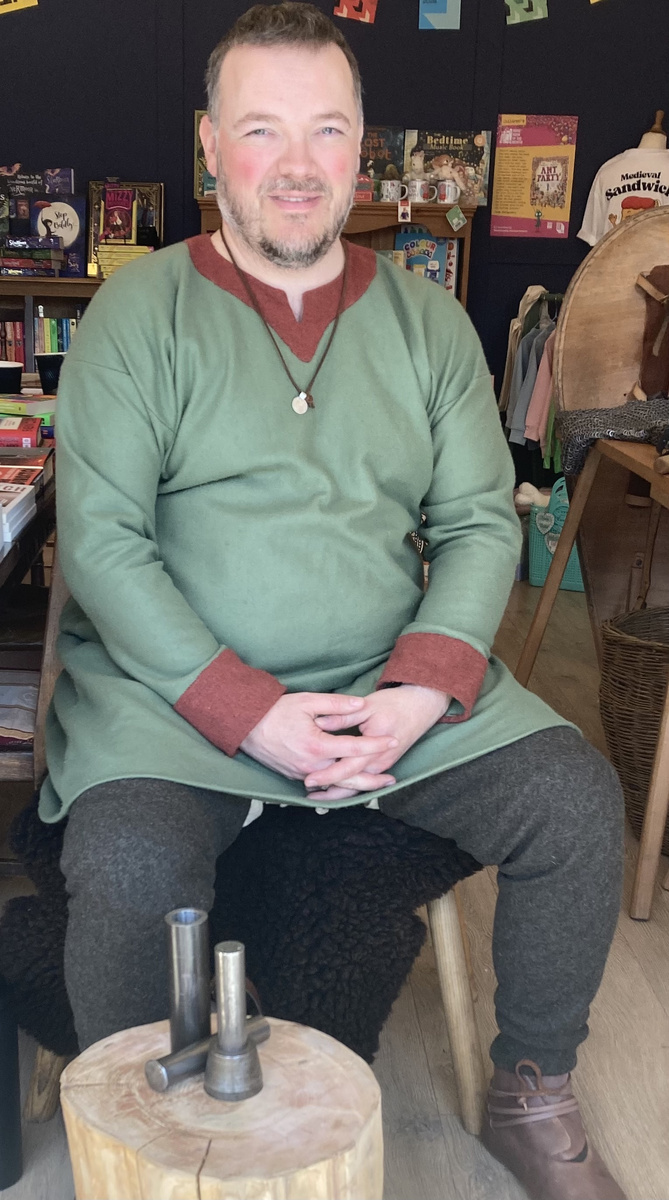
Frodi with his coin striking tools
But it’s important not to give too much significance to cash in the Anglo-Saxon economy. It’s not the only thing paying for goods and services in manors like Berewic, with its complex interdependencies, where often work was done in lieu, or payment made ‘in kind’. In fact barter was probably the first recourse for an exchange, even for the better off.
This extract from Thegn of Berewic shows Wulfstan’s brother Eadric being given land to farm and other material provisions at the hallmoot (the village meeting) by his thegn – his lord of the manor. But as a ‘gebur’, a peasant, he is also given a long list of duties he has to perform on his thegn’s land, by Cuthred the village reeve.
‘Eadric, we welcome you to Berewic and to our hallmoot. As a gebur and a free man, yet bound to your lord, you will receive from us seven acres of your yardland ready sown, the implements to work it, and furniture for your house. For stock you will have from us two oxen, a cow, and six sheep.’
Eadric bowed and began to turn away, but now it was Cuthred who spoke.
‘In return for this, you will work two days of every week in the year for your lord, and three days at harvest and between Candlemas and Easter. From the first breaking of the soil after harvest to Martinmas, you will plough an acre a week of the demesne, and fetch the seed to sow it from your lord’s barn. You will further plough two acres a year for your pasture rights, and three as rent for your own land, and provide the seed for this from your own.’ Eadric swallowed hard. He knew there would be obligations to work the demesne, the thegn’s own land, yet these were hard. ‘And if he so demands, you will plough a further three acres a year of the demesne.’
Eadric knew that Cuthred would make sure the three acres were demanded, but he bowed his head. Yet Cuthred had not finished.
‘In payments to your lord; ten pence a year at Michaelmas, twenty-three bushels of barley and two hens at Martinmas, and at Easter a young sheep. Or if you cannot lay hands on a sheep, two pence will do.’ At this, some in the hall sniggered. ‘For payments to the manor; as a freeman, a penny hearth tax to the priest, and six loaves to the swineherds when they take the herd to the denn in autumn. For duties to your lord; between Martinmas and Easter, you will take your turn in the watch over your lord’s fold. And with another, you will share the feeding of one of his dogs. It is not beneath you to feed a dog, I hope?’
More sniggers in the hall. Eadric’s fists were balled in fury, but he held himself in.
‘Is that all?’
Cuthred nodded. ‘Of course, you understand that if you die, all you have will be taken back by your lord. You’ll leave the world as you came to Berewic – with nothing.’
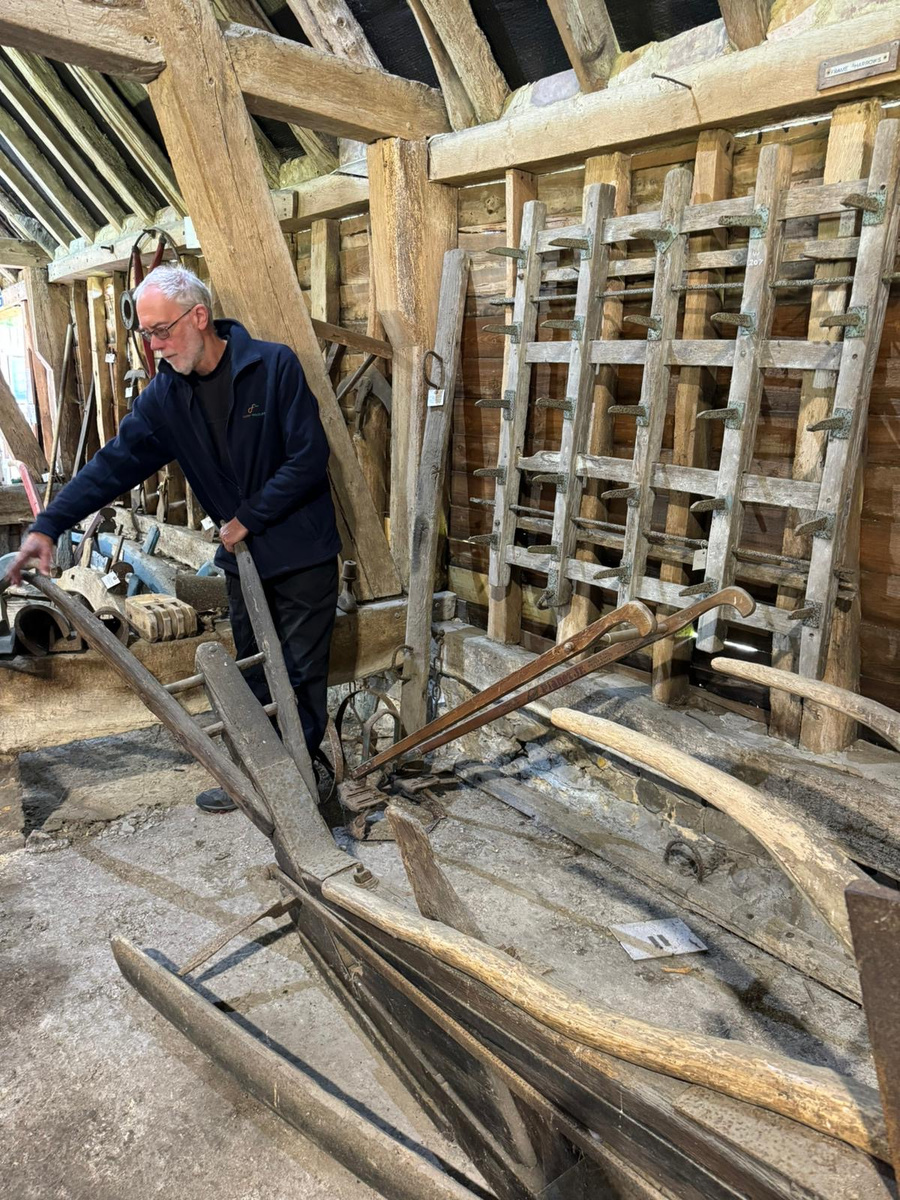
Eadric would have been given a plough like this one in Brook Rural Museum
I had this next talk ready for the afternoon at Sandwich, with another extract from Thegn of Berewic. I didn’t have enough people together at one time to do it, but here it is…
The Norman War Machine
It is the year 1071. William of Poitiers, a Norman soldier and later King William's chaplain, has written an account of the Battle of Hastings. Poitiers did not fight, but clearly spoke with many who had. He says in his account:
‘It was a strange kind of battle, one side attacking with all mobility, the other withstanding, as though rooted to the soil.’
That mobility is why the Normans didn’t just win the Battle of Hastings in 1066, but overcame the English in a 5-year aftermath – why the Norman war machine was so devastating. There are two key words in all this; castles, and cavalry.
Castles
To understand the role of castles, we need to understand what Normandy and the Normans were like before 1066. An early account of the Normans describes them as strong, fighting on horseback – and looking to expand. At this time the royal domain in France amounts to no more than a cluster of lands around Paris. In the rest of France, the king has no authority or control. Normandy is surrounded by competing duchies such as Brittany and Anjou, and France itself is at times its ally, at times its enemy. Any weakness will be exploited by a rival looking to expand, and the castle is key here. The castle with a motte (high mound of earth with a keep) and bailey (protected enclosure below the motte) we are so familiar with today – because it came in with the Normans – could be erected quickly, not just for defence, but as a means of attack, and control.
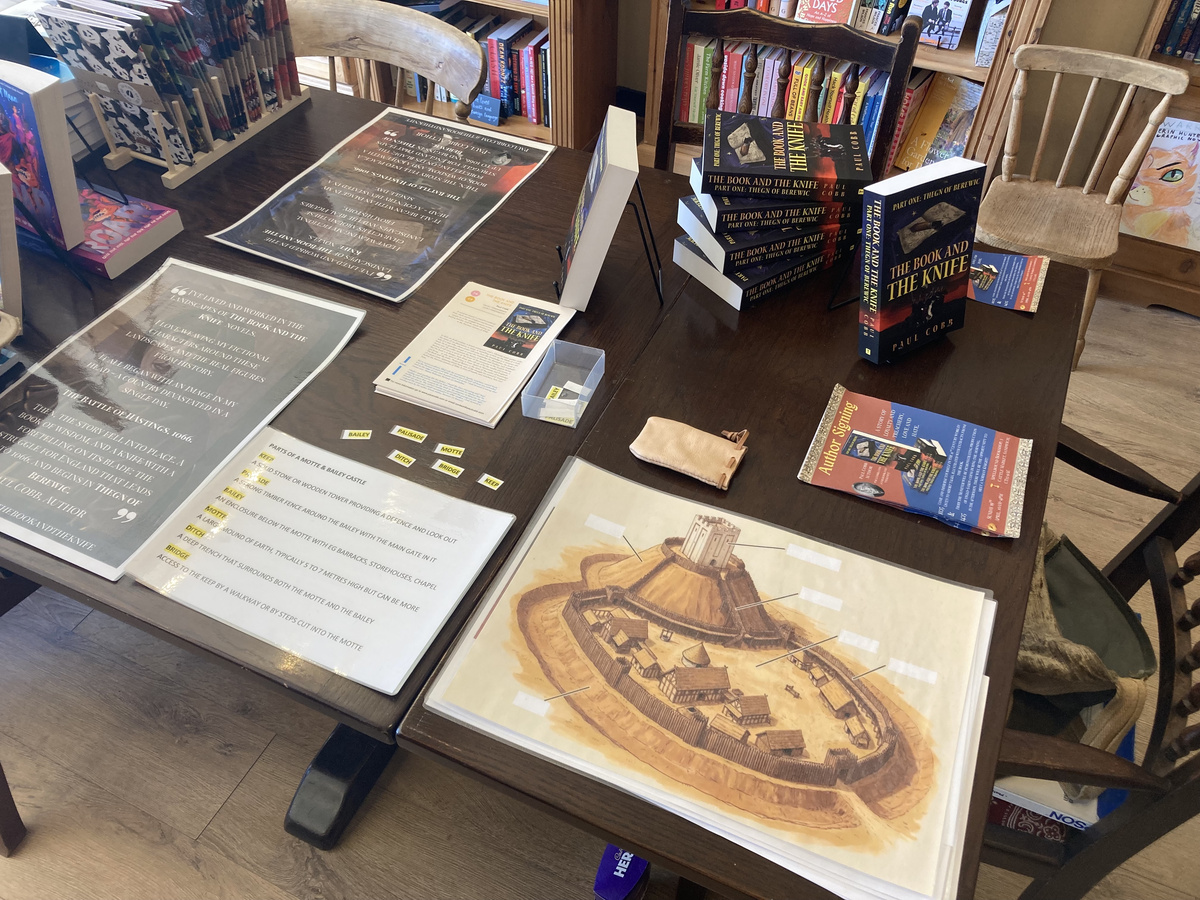
My motte and bailey castle quiz at Spellbound
Cavalry
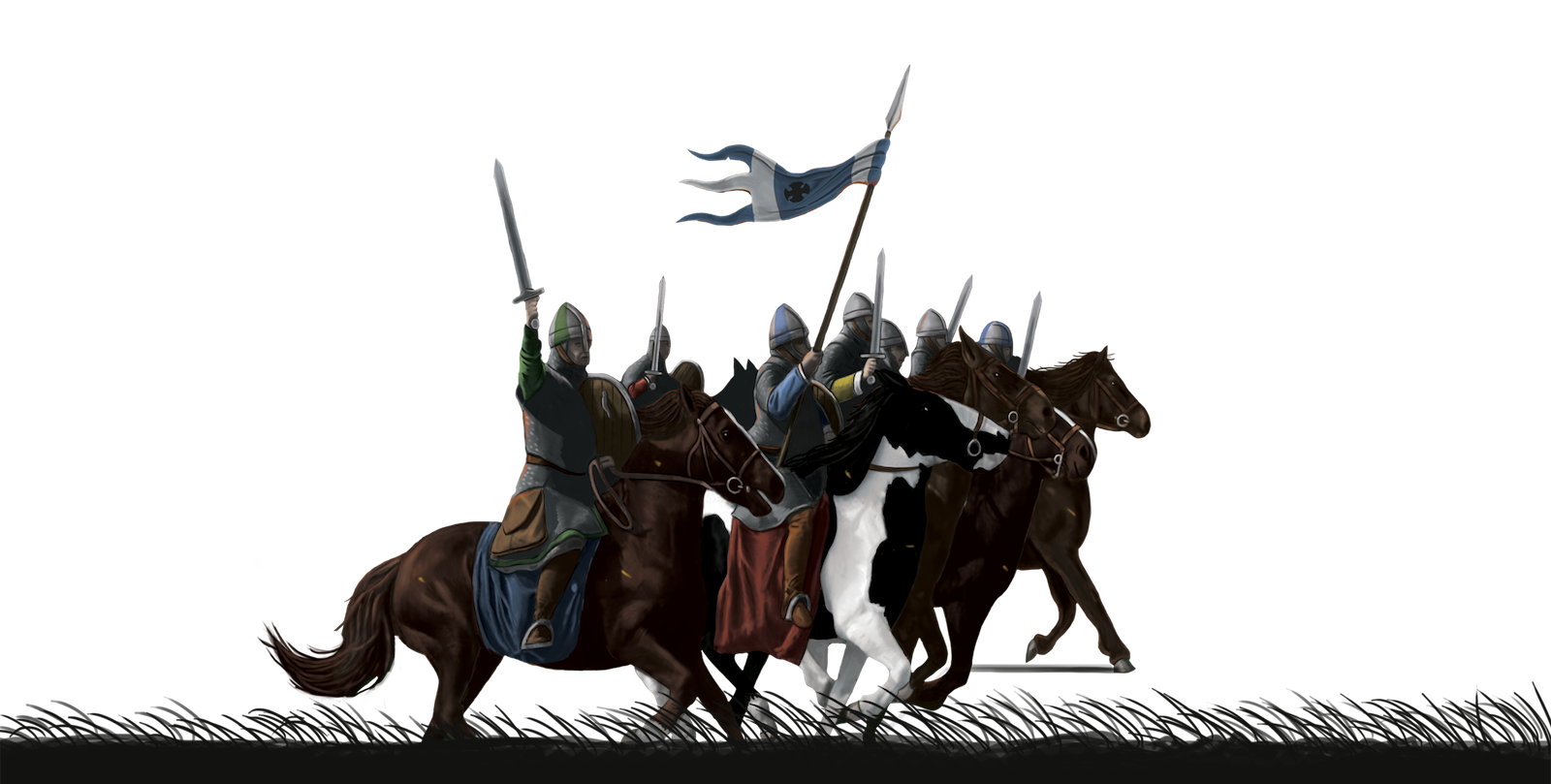
This is where cavalry comes in. A band of men equipped with horses, armour and weapons can ride out from the castle and devastate its opponents, and extract money from the local populace, who increasingly have to live close to its protection. When William becomes Duke of Normandy in 1035 at the age of eight, it is as an illegitimate son, although his father declared him his heir. William grows up constantly ‘beset by jealous nobles within and ambitious ones without’, as I have him say in the novel. Around him is a wolf pack of young men, who share his love of and skill in arms, fighting, and hunting, and they will protect him. But the Normans are Christian, and their dukes have long been promoters of the church. William is deeply pious, with a moral rigidity that justifies violence used for an end; for him it is serving God’s purpose. It is this belief that determines him on taking the English crown; he sees Harold as a usurper and England’s church as wayward and corrupt. And from the French for horse, ‘cheval’, we get ‘chevalier’, which becomes in English cavalry, men who fight on horseback, with an equivalent English word; knights.
What’s the impact of all this on the Battle of Hastings?
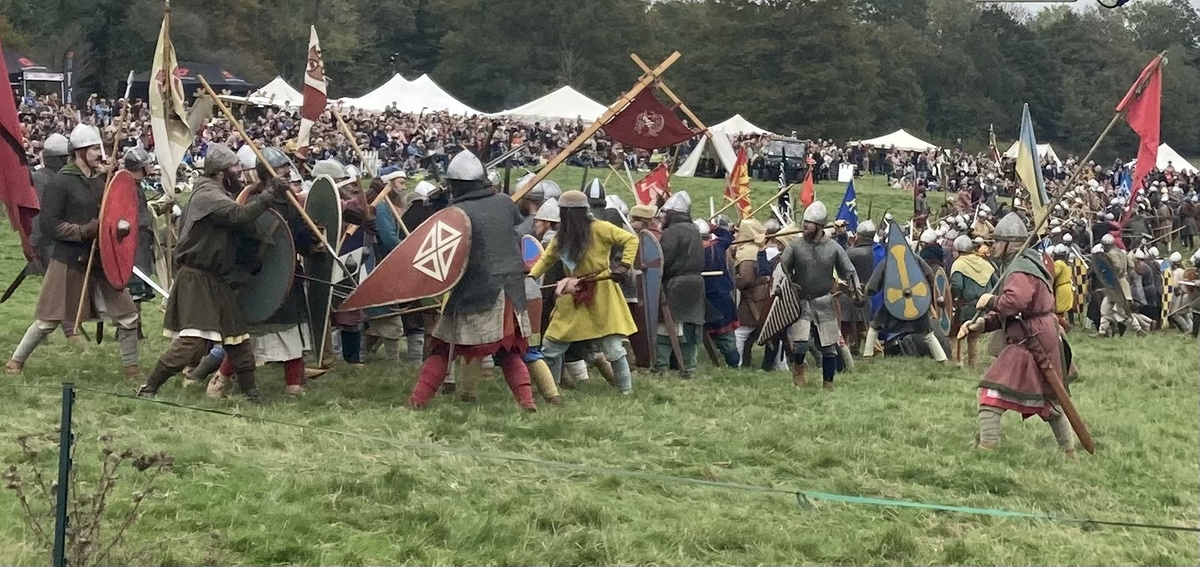
William brings a flat pack castle with his invasion fleet – all the timbers, even barrels of pegs! He uses this to put up a wooden castle at Hastings before the later stone structure. Hundreds of motte and bailey castles will be thrown up in England after the conquest. They become symbols of authority and repression to the English people, who were forced labour in their construction. On the day of the battle, Norman knights on their ‘destriers’, small but strong and nimble horses, repeatedly attack the English immobile shield wall. Yet it is not a simple or one sided conflict, and we mustn’t assume only their cavalry won Normans the battle. It is still a fight between infantry on both sides, that goes on all day.
But there is another description from William of Poitiers of the end of the battle:
‘The Normans… pursued [the English] relentlessly... even the hooves of the horses inflicted punishment on the dead as they galloped over their bodies.’
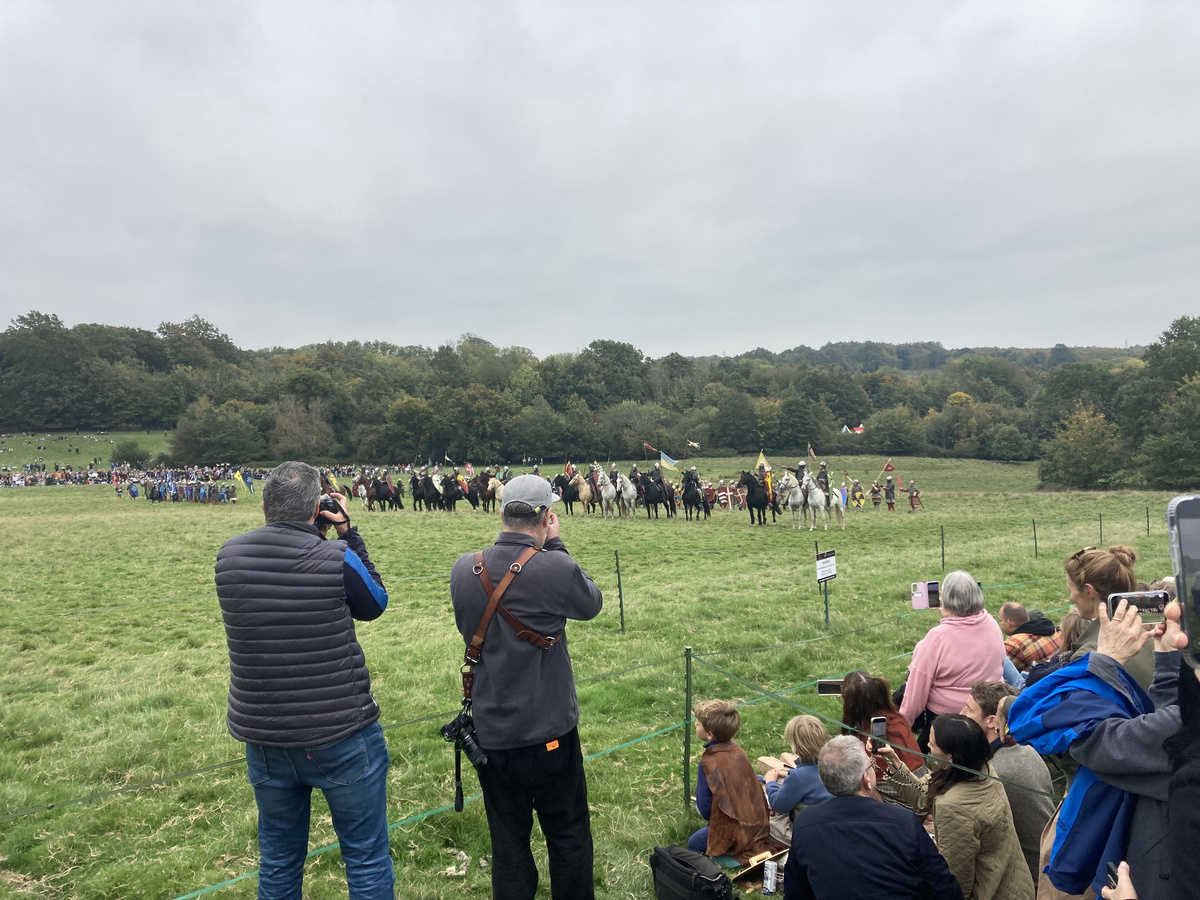
Here comes the Norman cavalry - Battle of Hastings reenactment 2025
An episode in Thegn of Berewic after William’s victory over rebels in Normandy at the battle of Val-ès-Dunes shows Wulfstan relishing his role as a knight to William, and his enjoyment in reliving the moment. And as Wulfstan relates what happens we also see Estraya starting to fall in love with him.
‘An army of twenty-five thousand they had between them,’ said Wulfstan. ‘We could count on not a third of that number. So we went to the French King. As Duke William is his vassal, he was bound to come to his aid. And he did, with ten thousand men. The rebels crossed the Orne to come after us, meeting on the plains south east of Caen. They wanted William dead. We joined with King Henri’s force at Valmeray, and we rode to meet them at Val-ès-Dunes.’
The firelight glowed on Wulfstan’s face and his blond hair, throwing his animated features into strong relief. Estraya sat on the ground, hugging her knees, watching him, spellbound.
‘We were still outnumbered,’ he went on, ‘and we knew we had little choice but to stand firm. Then Ralph Taisson, one of the rebel side, came up from the south with his force.’ He turned and spoke directly to Estraya. ‘Imagine what that was like. Us in our mounted ranks, foot soldiers on either side, watching them get nearer and nearer across the plain. I can still smell the horses, taste the dust in my mouth as we waited, braced for an attack. But Taisson came on alone; he rode up to William, and struck him with his glove. “I vowed to strike you,” he said, “and so I have. Now I will join you.” His men were not many, but there were knights on horse among them. With that force, and with William and King Henri’s skill, when battle was joined, we won more of the skirmishes. At one point Haimo unhorsed the French King, but before he could harm him was himself killed. Through the day we gained the upper hand, until the rebels broke and began to turn and flee; back towards the Orne.’ He paused and took a drink. ‘They started to cross the river but we came after them, cutting them down. Then panic set in; those not being hacked into the water flung themselves in to escape; but their armour weighed them down.’ His voice softened suddenly and he stood staring into the fire. ‘Unharmed or wounded, they all drowned. Their bodies joined the other dead in the river and were carried away…’
At Maidstone Medieval Fair Felip invited people along to morning and afternoon talks, and gave them the benefit of his opinions. Felip was forthright about William the Conqueror’s claim to be king of England, and what the Normans really did for us (when you discount all the bad stuff). Felip’s not English, or Norman – so whose side is he on? Thank you to Ann-Marie Langley, Arts and Culture Manager at Maidstone, for a great event, with lots going on.
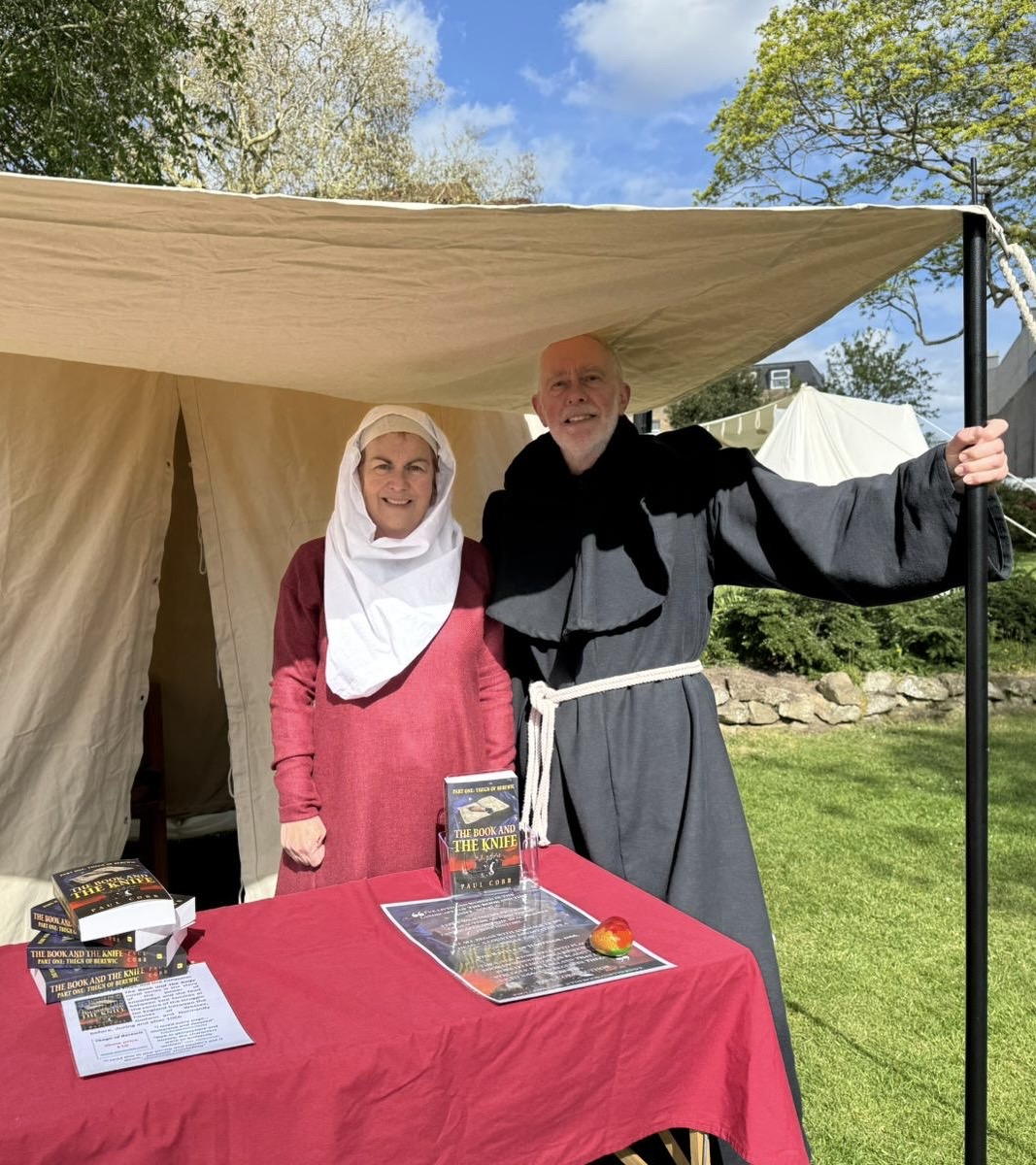
William of Normandy; upstart or rightful king?
“You’ve all heard the news – William of Normandy’s fleet is waiting to invade England: he’s got 700 ships, 7000 men, horses… even a flat pack castle! There’s nothing to worry about, if Harold Godwinson admits his taking the crown has all been a mistake and steps down… What do you mean, William of Normandy is an upstart, and Harold Godwinson is the rightful king?! I’ve no axe to grind for William of Normandy; I’m a monk from the Languedoc, but I can see I’m going to have to explain…”
“First: the throne is William of Normandy’s by right.”
“He’s King Edward’s cousin – his grandfather’s sister was King Edward’s mother, Queen Emma. Harold Godwinson has no royal blood – he’s not related to King Edward, just his brother in law, and his sister Edith and King Edward have had no children after 20 years. Being the most powerful earl and from England’s greatest family doesn’t give Harold Godwinson the right to be king. Being an able statesman and a great soldier and leader doesn’t give Harold Godwinson the right to be king.”
“William of Normandy has proved himself – he was born in 1027, the illegitimate child of the Duke of Normandy and the Duke’s mistress, Herleva. William becomes duke at the age of eight, and is constantly in danger. In 1047 he wins a great victory against rebels at the battle of Val-ès-Dunes. William has shown himself to be a brilliant military strategist, loyal to his friends, devastating to his enemies. William has a simple, relentless piety and is a great supporter of the church – he has abbeys built at Caen as well as Cerisy – my abbey! He promotes the brilliant churchman Lanfranc – compare him with Stigand the Archbishop of Canterbury. Stigand is not only a Godwin man, but corrupt. No wonder the Pope supports William of Normandy and has sent him the papal banner!”
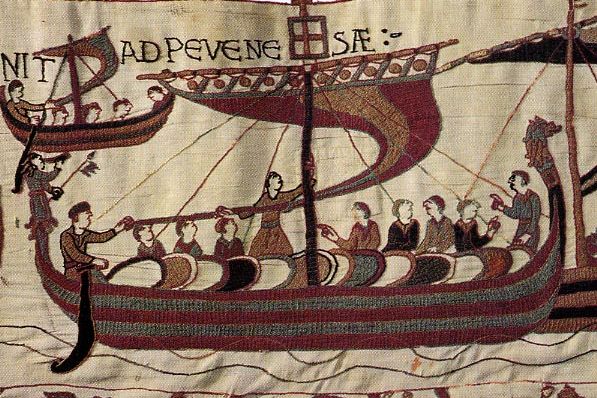
The Bayeux Tapestry shows the Norman fleet reaching Pevensey (source: Wikipedia)
“Second: the throne is William of Normandy’s by promise.”
“Harold Godwinson is one of the great Godwin family, who were all exiled by King Edward in 1051. At this point William of Normandy came to England and met Edward. It’s not in any English sources, but the Norman sources insist this is when King Edward promised William the throne – what do you mean, they would, wouldn’t they?!”
“Of course, a year later the Godwins return, and King Edward is back in their sway. This is not forgotten by William of Normandy – the more he sees of the Godwins’ power, the more determined he is to press his claim. Only two years ago, Harold Godwinson came to Normandy to affirm the promise of the crown to William. He might have been trying to get back his brother and nephew, who were being kept there as hostages, but Harold swore an oath to William on holy relics. You can’t go back on that! So when Harold Godwinson seizes the throne on King Edward’s death, William of Normandy is angry – Harold Godwinson is a usurper. And when Duke William is angry, you’ll all pay for it – you’d better get back to your homes, join up and get ready to fight. William’s not called the butcher of Alençon for nothing… cutting off the hands and feet of thirty-two hostages, to make the town surrender.”
“It’s all a sorry tale. Harold Godwinson and William of Normandy are both convinced they should be king. If it comes to a battle, no quarter will be given. One of them must die. If it’s Harold Godwinson and the English are defeated, England will never be the same again. You’ll want to forget the year 1066 ever happened. If only King Edward had had a son… Read all about it in The Book and the Knife… it’s a great story, and I’m in it a lot!”
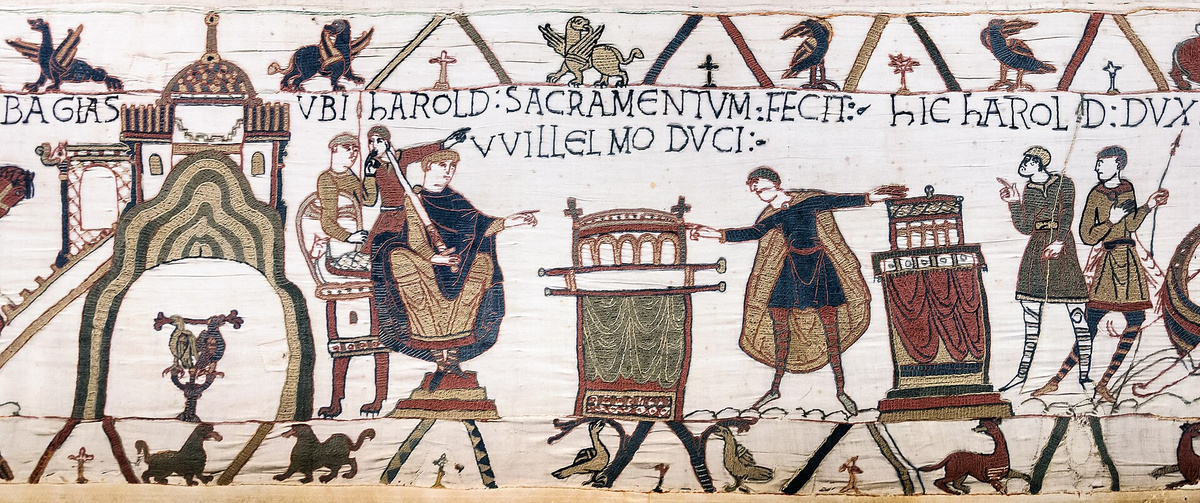
The Bayeux Tapestry shows Harold Godwinson swearing the oath (source: Wikipedia)
Yoke, what yoke?
“You’re all annoyed at this Domesday survey thing – what’s it all for, prying into everyone’s business – having to list every field, wood, mill, plough and ox? I know, tick the box, and next thing you’ll have someone selling you windows with glass in – I mean, who needs windows with glass in?! I’ve no axe to grind for William of Normandy, I’m just a monk from the Languedoc, but I can see I’m going to have to explain…”
“William of Normandy has been king for twenty years, and has decided he wants to know everything about England, and who owns what. It’s all become a bit of a mess, with rebellions, and people having their lands taken and given to Norman nobles. And William wants to know what everything is worth – so he can tax you all!”
“You poor English – you’re like oxen in the field, with a yoke round your necks, while the Normans lord it over you. How you’re doing, depends on if you’re part of the new order, or the old. In a takeover like the Norman conquest, you collaborate, keep your head down or actively resist. Take the English nobility – at King William’s recent council at Salisbury out of the 1000 tenants in chief he called together, only 13 were English. They resisted at Hastings, and have been taking part in rebellions ever since, so they’ve paid for their non-cooperation. England belongs to William of Normandy and his supporters – only 5% still belongs to native English. Normans have accumulated huge wealth – William’s half-brothers bishop Odo and Robert of Mortain, for example.”
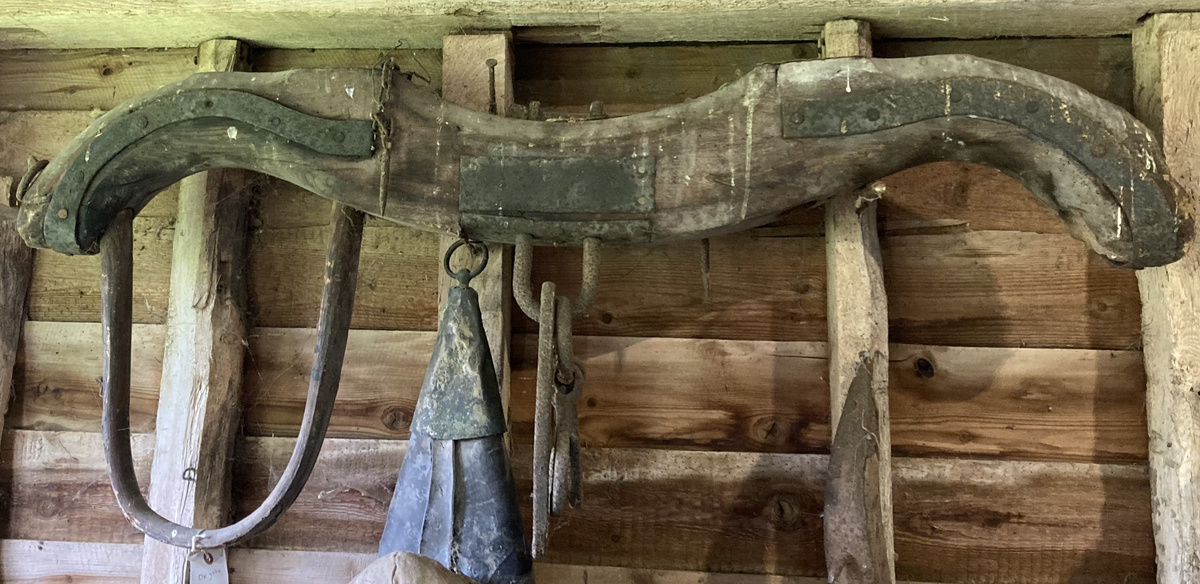
An oxen yoke in Brook Rural Museum
“In the church, out of sixteen bishops the only Englishman left is Wulfstan of Worcester, and the old Anglo-Saxon cathedrals are burning down or being demolished. Church reforms forbid priests to marry and the holding of multiple offices – like Stigand, the old Archbishop of Canterbury did. Monks are coming from Normandy to places like Canterbury, and churchmen like Lanfranc.”
“But what about the poor people and lower orders, like you? Thegns have disappeared – in the Norman hierarchy there’s no place for a middle order of landowners. Half of England now belongs to 200 barons, and half that is held by just 10 of them. The old order of Anglo-Saxon society has gone, with its rights and duties for all. Does it make any difference? Surely one lord is the same as another, if you’re a peasant?”
“And there are opportunities for others – for trade with Normandy, for the carpenters and masons building cathedrals, for monks like me. Some things have definitely got better. Domesday shows the number of slaves is lower, and it will die out – it’s morally wrong, and the Normans are opposed to it. There are magnificent new cathedrals like Canterbury, the list of English saints has been rationalised, church corruption is being rooted out. King William has encouraged Jews from Normandy to settle – there’s no persecution here. The Normans have brought in the notion of chivalry – decent conduct in warfare and in dealings between people. Only one English rebel has been executed since 1066, and there are no more revenge killings among the nobility. The English nobles used to bump each other off at feasts and weddings!”
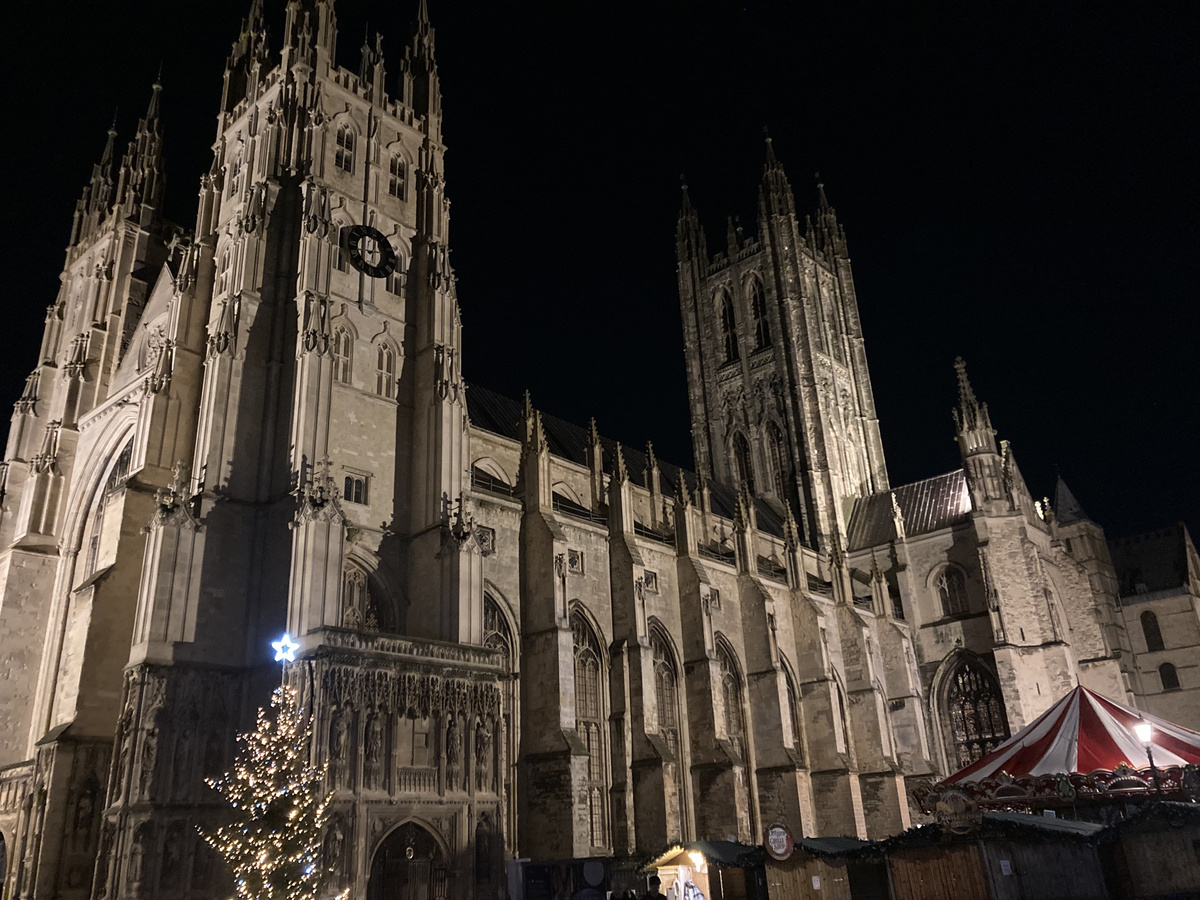
Canterbury Cathedral today
“Admittedly William of Normandy has had to destroy the whole of the north of England, leading to the deaths of tens of thousands, to stamp his authority, and keep the peace. And all these castles he’s had built are there to keep you all in your place… But I wager 1000 years from now no one will remember any of that – there’ll be no super rich, and we’ll all be equal… Read more about William of Normandy in The Book and the Knife… it’s a great story, and I’m in it a lot!”